Founder Insight Series: How to Make Your First Sales Hire

“World class hiring is the most important driver of sales success”
Mark Roberge, CRO at Hubspot
I’ve done hiring and firing and have been hired and fired. None of the firing was nice, all was necessary and all drew from terrible hiring processes.
An incorrect hire can set your company back 6–12 months. The opportunity cost of not having a fully-ramped hire amongst other costs are burdensome results of a terrible process.
So, what not to do…
- Hiring based on vanity metrics i.e. putting too much emphasis on brand names e.g ‘ex-Salesforce’
- Having an incomplete onboarding process
- Hiring without visibility on what the sales process looks like or awareness of the buyers’ journey
- Having undefined responsibilities for who will manage what part of the sales funnel
What the talent profile actually looks like

Seth from Point9 does a great job of defining what the profile looks like, here.
Let’s be clear, the job description of a first sales hire isn’t for everyone — especially graduates. The expectations require experience:
- Building out a sales playbook
- Ability to prospect, discover and qualify the market independently (without a playbook)
- Demanding time with founders
- Booking meetings, which is particularly undesirable for current AEs
Hiring someone inexperienced with hustle will almost always lead to burn-out, and hiring someone with too much experience might lead to them not executing the mundane tasks like booking meetings.
The Hiring Process
Mark Roberge deduced the top 14 qualities to look out for from examining the top performing account executives from Hubspot:
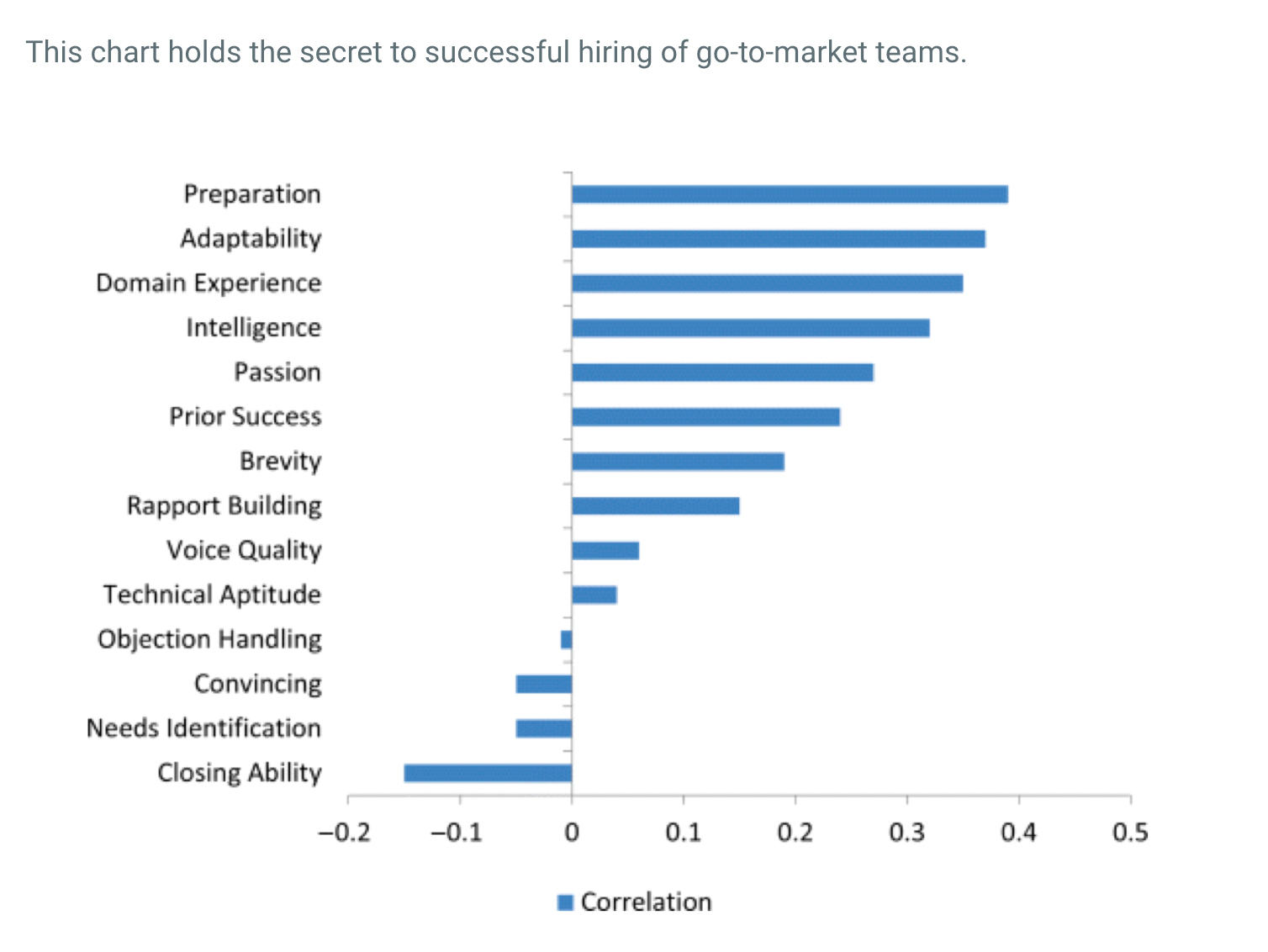
There’s a simple 4 step process to help you identify your own characteristics and process to discover and hire the best candidate for your context:
Step 1: Make a theory about ideal characteristics
If you could be granted whatever your heart desires, what are the characteristics you believe would lead to sales success, given your experience with the buyer?
The best way to sift out these qualities is to first categorize them in the following way:
- Selling skills (natural networker, powers of persuasion, good communicative style, keen observer, attention to technical detail)
- Working style (are they a strategic thinker, collaboration skills, adaptability)
- Character traits (tenacity, inquisitiveness, passion)
For each characteristic, define it in black and white, as you’ll have to score candidates against it from 1–10.
Step 2: Define an evaluation strategy for each characteristic
You now need to plan how you might evaluate a candidate on each characteristic. You might use behavioral questions, role plays, an exercise prior to the interview, leverage reference checks, a mix of structured and unstructured interviews etc.
Here are some examples of characteristics and questions:
- To assess proactivity:
a) Given your understanding of the role, how would you approach your first 90 days?
b) Can you provide us with an example where you have achieved x in a y amount of time and had to engage with stakeholder a and b? - To assess self awareness you can conduct a roleplay and ask them to evaluate themselves
Step 3: Score each candidate against your ideal characteristics
Using the definitions of success you have outlined in Step 1, now is the time to rank your candidates’ performance against each characteristic.
In cases where there are more than one interviewer, make sure to blindly record your scores and discuss at a later date and you can use the averages of your scores if everybody holds the same level of decision making power.
Step 4: Learn and iterate on the model over time
After completing a few hiring cycles you will be able to spot patterns over time and re-categorise the importance of each characteristic.
You will be able to list the common characteristics of top performers and reprioritise these for your next sales hires.
Additionally, you will also be able to highlight any traits that you left out in your first few hires and incorporate them into the categories to actively look out for.
And there you have it.
The step-by-step methodology highlighted above will help make your first hiring decision go as smoothly as possible.
The important thing to note here is that every company has its own culture and incorporating this into your processes is important in building a more authentic environment. Also, bring others into the process.
We’re practical investors. Beyond supporting our portfolio on qualification frameworks, you can find us building SDR compensation plans, advising based on recorded sales calls, leveraging our network and LPs to make introductions and more. We're investing in B2B SaaS, solving deep pains and/or creating opportunities in the order of magnitude for a defined buyer. If you’re looking for investment, reach out via our pitch-us form, and we’ll respond within 14 days.

The latest
from Haatch
Haatch backs Falkin to build the future of digital safety
We’re excited to announce our latest investment in Falkin, a London-based startup redefining scam prevention for the AI era. Falkin has raised a $2 million pre-seed round led by TriplePoint Ventures, with participation from Notion Capital, BackFuture Ventures, Aviva/Founders Factory, Found Capital, and Haatch.
Bigger Cheques, Better Runways: How Haatch Turns UK Regional Imbalance into Investor Advantage
According to the British Business Bank’s Small Business Equity Tracker 2025, smaller companies raised around £10.8bn of equity investment in 2024, making it one of the highest years on record despite a tougher macro backdrop.
Adclear Raises £2.1m to Redefine Financial Promotions Compliance with AI
We’re delighted to share that Haatch portfolio company, Adclear, has raised an oversubscribed £2.1m Seed round led by Outward VC, alongside AFG Partners and Tenity.
Why the Budget Should Give Advisers Confidence in SEIS, EIS and the UK’s Venture Momentum
For advisers, this Budget comes at a time when clients are increasingly looking for planning tools that feel stable, strategic and defensible. With talk of potential tax rises and long-standing incentives facing scrutiny, many clients are reassessing their options.