Headcount Is Dead as a Growth Metric. Here's What Our Portfolio Data Says Replaced It.
For two decades, venture capital used a crude proxy for progress: how many people have you hired? Team size signalled ambition, traction, momentum. If a seed-stage company doubled headcount, it was "scaling."
Our portfolio data now tells us that era is over.
Across roughly 200 early-stage B2B software companies we track, median revenue growth over
the past two years ran at around 50% annualized. Median headcount growth over the same
period?
Zero.
Read that again. The typical company in our portfolio grew revenue by half
without adding a single net hire.
Drill deeper and the picture sharpens. In a matched cohort of companies we've tracked since late 2024, median revenue per employee rose from roughly £50k to £80k — a 62% improvement in 21 months. Our applied AI companies now generate a median £54k of revenue per full-time employee against £44k for the rest of the portfolio, and that gap is widening. The fastest-growing cohort in our portfolio — AI-native companies compounding revenue at a median of nearly 200% annualized — did it while growing teams modestly, not by throwing bodies at the problem.
This is the AI-native efficiency era arriving at seed stage. The ten-person company doing £1m+ ARR is no longer an outlier; it's becoming the template.
Fewer people, but the people matter more
Here's the contrarian point we want to stress: if headcount no longer drives growth, then the individuals who remain are the entire ballgame.
When a company runs on eight people instead of thirty, there is nowhere for mediocrity to hide. Every hire is a meaningful percentage of the company's total capability. Judgment, adaptability and taste — the ability to decide what the machines should do — become the scarcest resources in the business. Software is increasingly abundant; exceptional people are not. The long-term competitive advantage has shifted decisively from the size of the team to the calibre of it.
Smaller, leaner, hungrier teams are who we are backing.
That has always been the Haatch philosophy, and it matters more now than ever. As we often say: “We back the jockey, not the horse. Products, models and entire categories are being rewritten every six months — the only durable bet is a founder with the ability to steer through that rate of change and come out ahead of it.”
The data backs the discipline, too. Median runway across our portfolio has improved from nine months in autumn 2024 to twelve months today. Capital efficiency isn't a downturn behaviour that will unwind when markets loosen. It's a structural shift.
The smart money has noticed
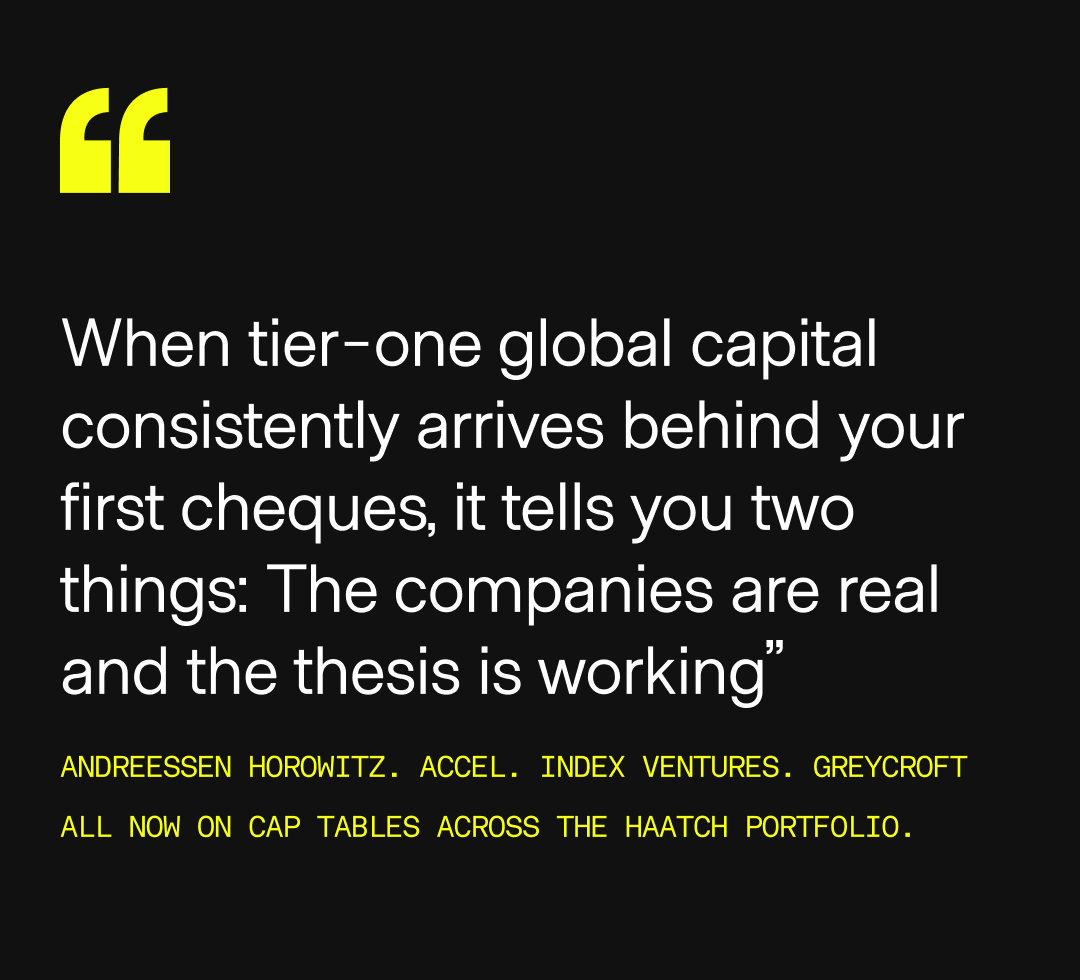
We're not the only ones seeing this. The kind of lean, capital-efficient, founder-led companies described above are exactly what the world's best investors are hunting — and it shows on our cap tables. Investors backing or following on in our portfolio now include Andreessen Horowitz, Accel, Index Ventures, Greycroft and Lerer Hippeau, alongside leading European funds such as Breega, Speedinvest and BMW Ventures.
When tier-one global capital consistently arrives behind your first cheques, it tells you two things: the companies are real, and the thesis is working. Backing small teams of exceptional people, early, remains the best seat in venture. The data just made the case louder.
Growth figures are anonymized medians drawn from portfolio companies reporting revenue over a six-month-plus span (59 of ~200 companies), July 2024 – July 2026.

The latest
from Haatch
Haatch exits Trigify to HubSpot at up to 3.53x
We are delighted to announce the successful exit of our full position in Trigify following its acquisition by HubSpot, the agentic customer platform for scaling businesses. The all-cash transaction delivered up to 3.53x for our investors. This exit represents Haatch’s 6th profitable exit in the last 18 months.
British Business Bank backing for Haatch reaches £62 million
A further £10 million commitment takes investment in Haatch's pre-seed and seed funds to £30 million, sitting alongside the £32 million angel syndicate platform Haatch manages on the Bank's behalf making Haatch the largest of all programme partners.