Software is back, apparently. Our numbers say it never left.

In February, the stock market decided software was finished. Last week it decided software was back.
Between the 12th of January and the 23rd of February, the main index of American software companies lost a quarter of its value. More than $285bn disappeared in six weeks, set off by a new crop of AI agents that do the kind of office work software companies charge for. Someone called it the "SaaSpocalypse" (SaaS being the industry's word for subscription software) and it stuck.
Then, on the 27th of August, Salesforce reported its results, raised its forecasts, and its shares rose more than 20% in a day, the second-best day in the company's history. On the All In podcast that week, David Sacks called the whole story "totally overdone". His takeaway: "simple extrapolations of the future based on these trends don't work out." The extrapolation in question: "AI agents can code, therefore all software is going to zero."
The part that matters for us
The interesting bit was not the gloating. It was the exception the hosts carved out.
Their view is that the survivors are the big general-purpose products every industry uses: customer databases, email, spreadsheets, payroll. Nobody is going to rebuild those. The danger sits with software built for one industry. David Friedberg put it plainly: "It's more of a vertical SaaSpocalypse." Chamath Palihapitiya agreed "100%". Jason Calacanis said he was betting against that kind of company. Only Sacks held back, saying it was "case by case" and depended on how much the customer relies on the product.
Friedberg's reasoning came from experience. His own company built a customer database over a weekend with AI coding tools. It worked, until it needed security, access controls and a dozen other things, and in the end they bought Salesforce. His conclusion: companies will point their AI effort at software specific to their own business and buy the general stuff off the shelf. The specialist vendors lose.
That is most of what we back, and most of what is crossing our desk right now: software that checks insurance claims for fraud, runs a hotel's guest desk, or helps a bank decide which small businesses it can lend to. Built for one industry, sold to a few dozen customers, at a stage where a customer could still cancel with a month's notice. If the vertical SaaSpocalypse were real, it would show up here first.
So we checked.
What our numbers say
We track roughly 200 early-stage software companies. To keep this fair, we looked only at the ones that had already proved something: at least £100,000 of annual revenue in July 2025 and a reported figure a year later. About half of that group sells into a single industry.
Over the twelve months the market spent panicking about software:
- 82% of them grew. The typical company grew revenue by 41%. Between them, revenue rose 58%.
- The companies built for one industry grew by the same amount as everyone else: 41% against 42.5%, with the same 82% share growing.
- The bigger they were, the better they did. Of the industry-specific companies that started the year above £250,000 of revenue, 92% grew, and the typical one grew by 53%.
- It was a better year than the one before. In the twelve months to July 2025, the typical industry-specific company grew by 32%, and 69% of them grew at all. This year: 41% and 82%.
Put the panic on a chart and the line barely notices it. Typical annual growth for industry-specific companies with real revenue was 15% in February 2025. By February 2026, the month the selloff took hold, it was 45%. In July it was 41%.
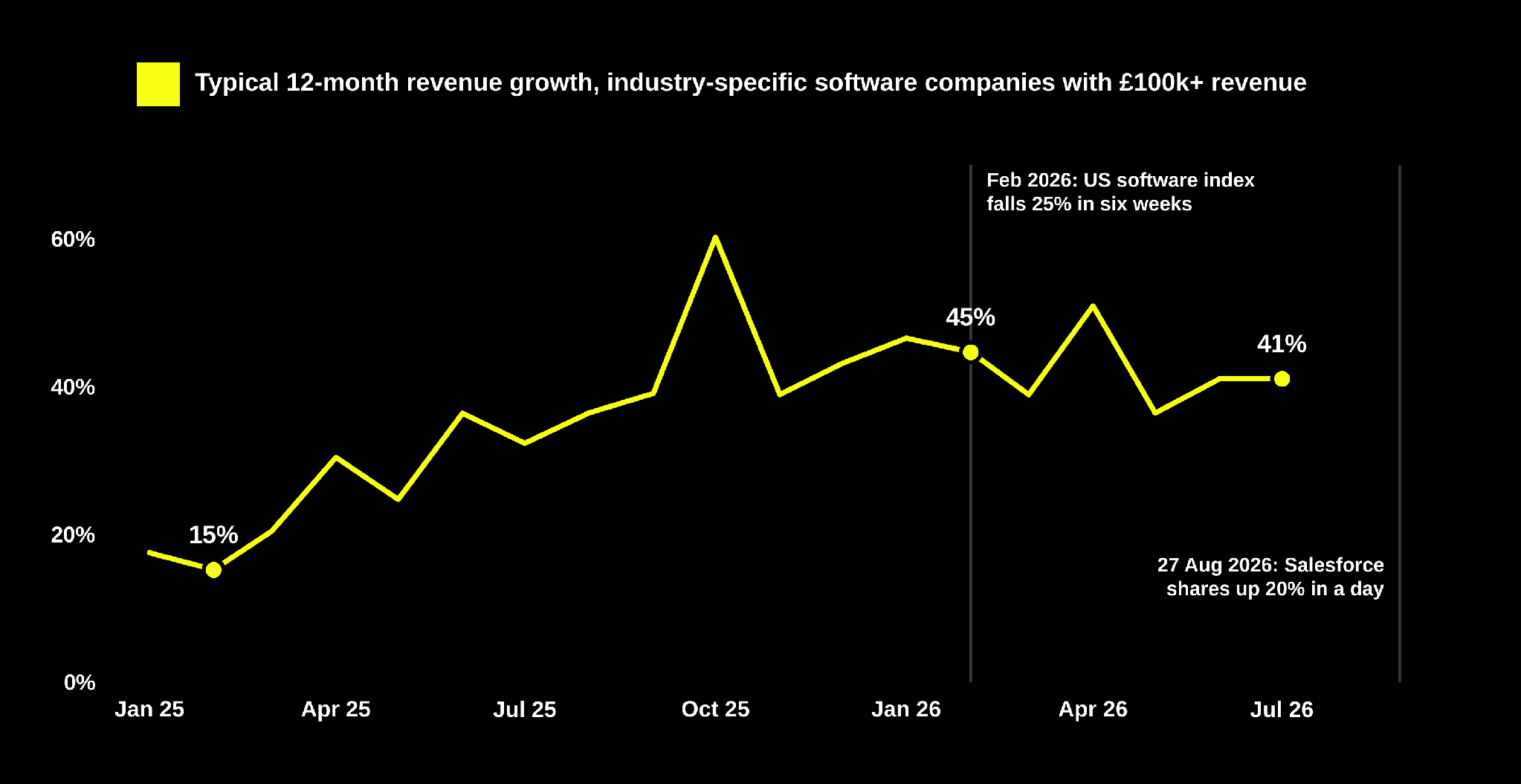
Chart: typical growth over the previous twelve months for industry-specific companies in the Haatch portfolio with at least £100k of annual revenue at the start of each period.
We will be honest about the one wobble. Growth in the first half of 2026 was slower than in the six months before it (18% against 28%), and the share of companies growing slipped a little (72% against 74%). One slower half, from a higher base, in the middle of a panic about the entire category. Nobody was blown up.
Why the podcast drew the line in the wrong place
The hosts split software into "used by every industry" and "built for one". Our data says that is not the line that matters. Sacks came closest when he said it depends on how good a "system of record" the product is. In plain English: does it hold the version of the truth the customer runs the business on?
That is where specialist software has the advantage, not the weakness. Chamath's own framework says AI is entering a phase where agents need context to do a real job rather than answer questions. The context needed to spot a doctored invoice, or to know that room 412 has complained twice this week, lives in the specialist tool, not the email system. An insurer or a hotel group is no more likely to build that itself than Friedberg was to rebuild Salesforce. The do-it-yourself threat is real, but it is aimed at generic internal tools, which is precisely the kind of software we do not back.
Why now
Two things happened at once this year, and together they make this a good moment to invest.
The first is what you have just read. The companies the market wrote off kept growing, and the ones with real revenue grew faster than the year before.
The second is where the money went. In the first half of 2026, companies building AI for a specific industry made up 63% of AI deals but received just 13% of the money. The big general-purpose platforms and frontier labs took 71%. In the UK, three AI companies took 29% of all equity capital raised in the first half, and the number of deals across the market fell as a result. So the businesses that grew through the panic are raising money in a market where most of the capital is looking the other way.
We see it every week. Every business we are working on for the fund that closes this month sells into a single industry. Most of their founders spent their careers inside the industries they now sell to. Most of them have at least doubled revenue in the past year.
The February extrapolation was that AI can code, so software is worthless. The August version will be that software is back, so buy anything. Both are lazy. The opportunity sits between them: businesses whose customers kept paying through the panic, run by founders who are raising while the crowd looks elsewhere.
That is what we are buying this month.
We have shared an anonymised note on the five businesses we are working on for the current fund. If you would like to see this, you can at this link: https://haat.ch/eis-24-anon-pipeline
Risk warning: Investing in early-stage companies involves a high level of risk, including loss of capital, illiquidity, and dilution. Past performance is not a reliable indicator of future results. The tax benefits of SEIS & EIS depends on the individual circumstances of each client and may be subject to change in future. This communication is for informational purposes only and does not constitute investment advice. Before making any investment decisions seek appropriate independent investment and tax advice.

The latest
from Haatch
Haatch exits Trigify to HubSpot at up to 3.53x
We are delighted to announce the successful exit of our full position in Trigify following its acquisition by HubSpot, the agentic customer platform for scaling businesses. The all-cash transaction delivered up to 3.53x for our investors. This exit represents Haatch’s 6th profitable exit in the last 18 months.
British Business Bank backing for Haatch reaches £62 million
A further £10 million commitment takes investment in Haatch's pre-seed and seed funds to £30 million, sitting alongside the £32 million angel syndicate platform Haatch manages on the Bank's behalf making Haatch the largest of all programme partners.